
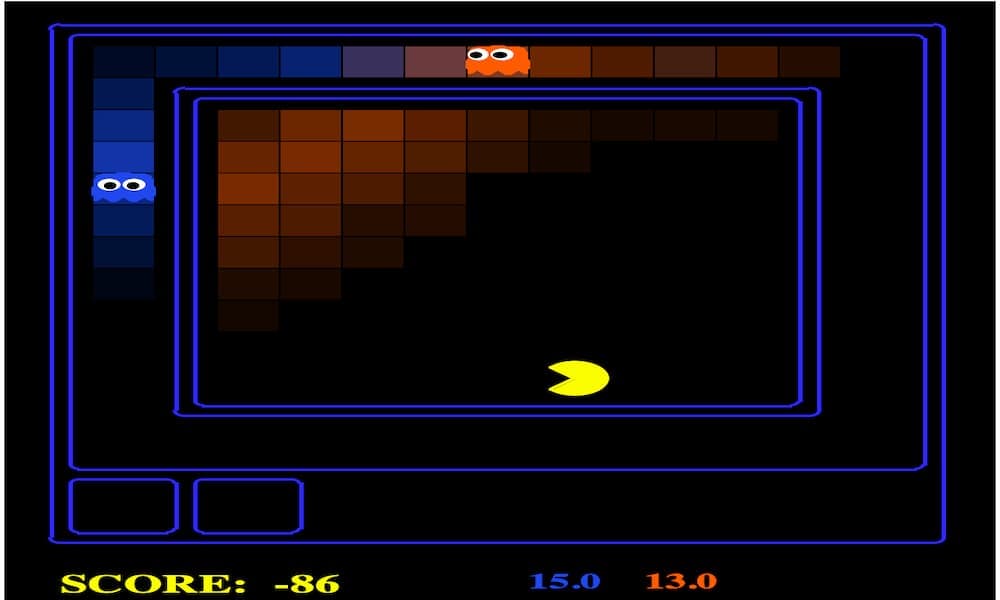
Overview
Techniques & Concepts
- Bayesian networks & factors: Represented dependencies between variables using factors and factor operations.
- Exact inference: Implemented variable elimination to perform exact belief updates over ghost positions.
- Approximate inference: Implemented particle filtering to scale inference to multiple moving ghosts.
- Belief tracking: Maintained belief distributions over time as Pacman moves and receives new evidence.
- Noisy observations: Handled uncertainty from imperfect distance sensors.
Result
- Pacman can localize single and multiple ghosts even when they are not directly visible.
- Belief distributions over the grid evolve as Pacman explores and gathers new sensor evidence.
- The agent combines inference with path planning to aggressively hunt ghosts.
What I Learned
- How to represent and update uncertainty using probability distributions.
- The practical differences between exact and approximate inference.
- How probabilistic reasoning can be integrated with planning to guide intelligent behavior.
.jpg&w=3840&q=75)